“Left of boom” is a military phrase for the period before an incident, when you can still prepare and avert a crisis. Our name and our practice rest on one idea: the work done before a crisis determines how well an organisation performs during one. Three connected models bring it to life, the boom line, the capability maturity model, and the eleven elements of crisis management.
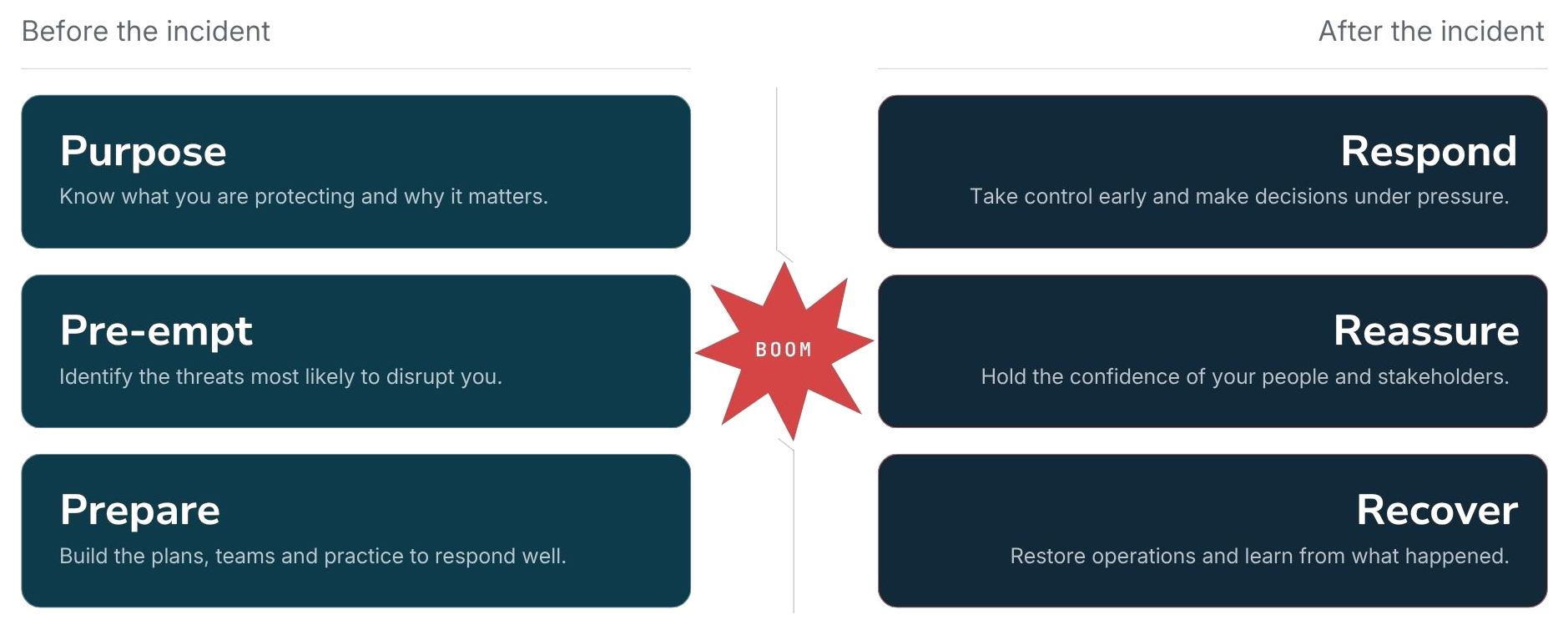
Everything before the incident: understanding your people, environment and stakeholders, then building plans, training teams and rehearsing the decisions that matter most. This is where risk is reduced and confidence is built.
Everything after the incident: activating the plan, leading under pressure, communicating with stakeholders and adapting as it develops, through to recovery and the lessons that follow.
Most organisations invest heavily to the right of boom and far less to the left, yet the left is where preparation quietly determines the outcome. That is where we concentrate, helping leaders predict, pre-empt, detect and respond to emerging threats with confidence.
A way to see where an organisation's crisis capability sits today, and the journey ahead of it.
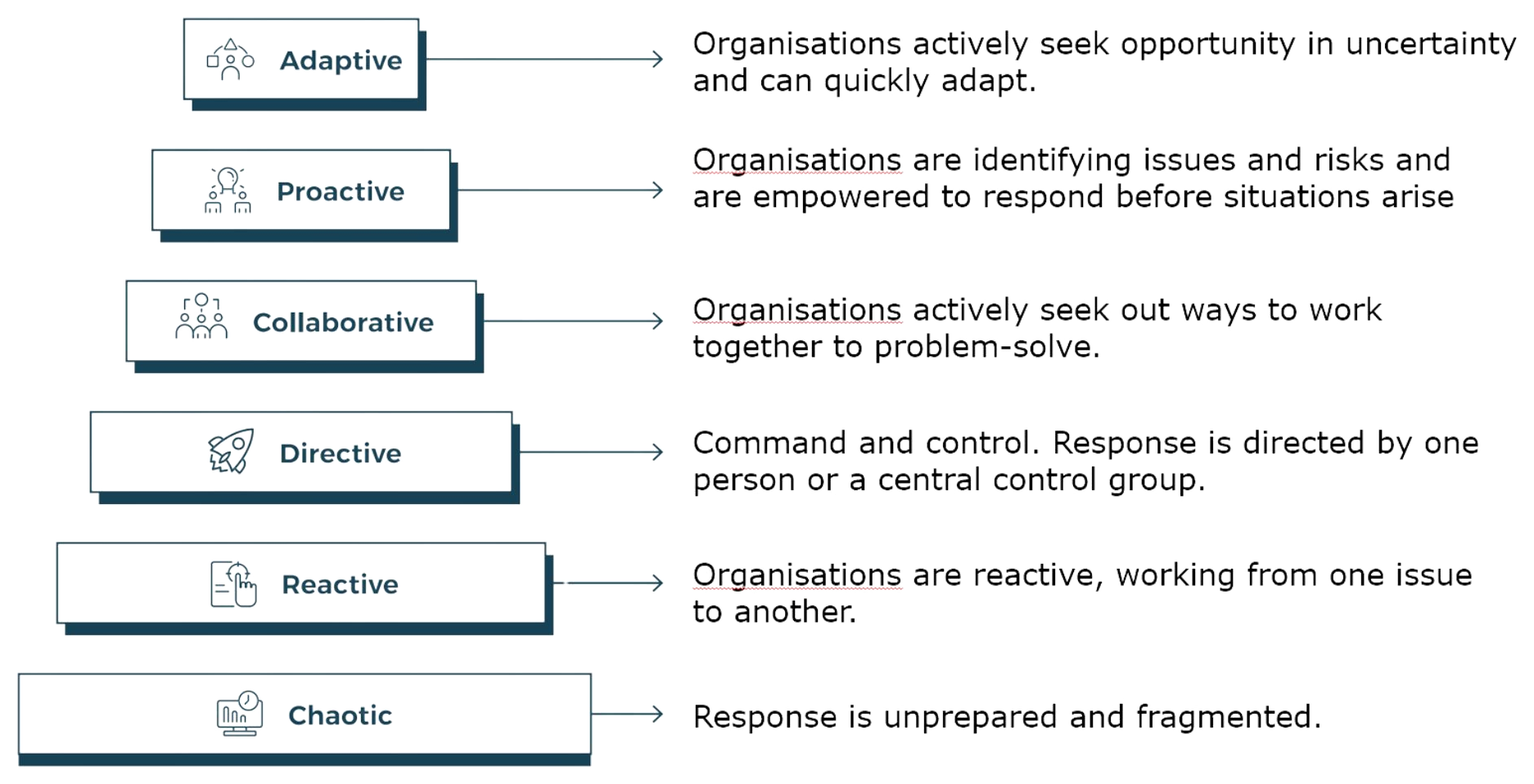
Six tiers of crisis maturity, from least to most mature: Chaotic, Reactive, Directive, Collaborative, Proactive and Adaptive. The illustration describes what each level looks like in practice.
Its purpose is to make an under-appreciated capability visible. Crisis capability is easy to overlook until the day it is needed, and hard to argue for without a common language. The model gives boards that language.
Placing an organisation on the model lets us track its journey, benchmark it against peers, and make the case for the investment needed to move up. The goal is not perfection at the top, but honest awareness of where you are and a clear path toward greater resilience.
The fundamentals of a capable crisis and resilience program. Together, these elements describe what good looks like, and they span both sides of the boom line, from preparation through to response and recovery.
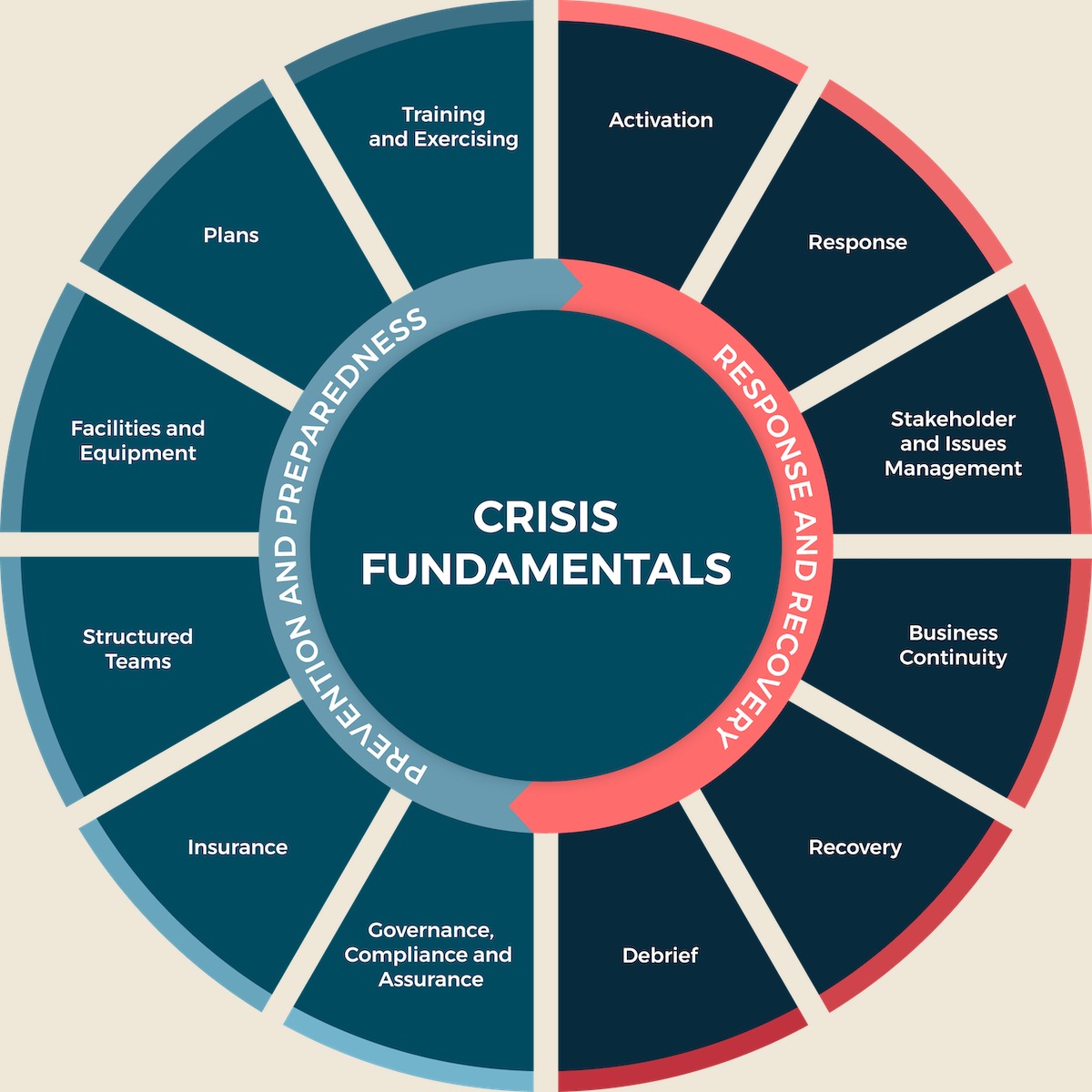
Training and Exercising. Role-based training that keeps the people with a crisis role competent and current, reinforced by regular exercises that test the arrangements and turn lessons into improvement.
Plans. Current, integrated crisis, continuity and communications plans built on your real risk profile.
Facilities and Equipment. A ready place to run a crisis from, primary and alternate, physical or virtual, equipped with the tools, communications and supplies the team needs, including the log-keeping and information sharing systems that maintain a shared, common picture as the situation unfolds, with resilient backups when normal channels fail.
Structured Teams. Clear roles, deputies and decision authority that scale to the size of the event, underpinned by visible executive commitment and leaders prepared to decide under uncertainty.
Insurance. Cover that responds when it's needed, understood and tested before a crisis, not discovered during one.
Governance, Compliance and Assurance. Clear accountability, standards alignment and assurance over the whole program.
Activation. Detecting, escalating and standing the team up quickly, at any hour of the day.
Response. Taking control early, making decisions under pressure and directing the actions that contain the immediate impact.
Stakeholder and Issues Management. Knowing your audiences, communicating with them under pressure, and managing the issues a crisis brings to the surface.
Business Continuity. Keeping critical operations running, or restoring them fast, so the business continues to serve customers through disruption.
Recovery. Restoring normal operations and confirming the organisation is genuinely back on track, not just past the immediate crisis.
Debrief. Capturing lessons learned while they're fresh, and converting them into practical improvements to plans, training and structures.
The three models are designed to work together. The boom line is the philosophy, the reminder that the work done before an incident determines the outcome. The eleven elements are the fundamentals of what good looks like, and they span both sides of the boom line, from preparation through to response and recovery.
An organisation's capability across those eleven elements is then assessed to place it on the capability maturity model. In other words, the eleven elements are what we measure, and the maturity model is how we express the result, showing where an organisation sits today and the journey ahead. Assess honestly, benchmark against peers, and invest deliberately to move from reactive toward adaptive.
Left of Boom's founder, Grant Chisnall, has found that the difference between organisations that respond well and those that don't is trust, in each other, their team and their processes. That trust isn't built by any single plan; it reflects how well prepared a team is before the crisis begins.
Adaptive teams don't just react. They respond with confidence, work together, and treat the event as a chance to learn and adapt, emerging stronger. Read more on trust and adaptive teams →
The models draw on Grant Chisnall's military background and fifteen-plus years advising executive teams through some of the most significant crisis events in recent Australian and New Zealand corporate history, codified in his book, Boom or Bust: Survive and Thrive During Crisis, and explored further on Crisis Podcast.
